Automationas a service.
There's work in your company nobody should be doing by hand.
We automate it and then we run it, month after month. You don't end up with one more system to manage.
At the end of the month you know how many hours your team stopped spending and how much work went through on its own. It's on screen, you don't have to ask for it.
If something breaks we fix it, and we usually find out before you do.
What we do
There are two reasons someone is still doing it by hand.
Someone has to sit there and click
Bank portals, supplier portals, old systems that won't connect to anything. The only way to get the information out is to go in and do it by hand, and someone on your team is doing that every day. We do it instead of them.
This is usually where the heaviest hours are.
A person is the bridge between one system and the next
Data comes out of one side and has to go into the other, but nobody ever connected the two ends. Someone copies it and re-enters it. Same with the invoices and contracts someone reads just to pull one number out, and with the report that gets rebuilt every week.
We do the same thing in both cases. We build it, we run it, and you watch it work every day.
If the process needs to understand text, like an invoice or an email, we use AI. If it doesn't, we don't.
How we start together
We come in through one process. We stay for the rest.
Most of our clients met us solving something small. Nobody hands a stranger their core system, and they shouldn't. So we start where the result shows up in weeks, and we earn the rest.
The process that hurts most
We take the one eating the most hours and we solve it. Weeks, not quarters. Small enough that you're not betting anything on us.
The number, not the promise
It runs, and you log in and see what it did: hours saved, volume processed. You don't have to take our word for it.
The next one shows up
The first process exposes the next one. Up comes the system that talks to nothing, or the spreadsheet half the operation depends on that one person maintains.
Now it's the whole system
At some point the problem stops being fixable by automating a step and the system has to be rebuilt. By then we know your operation well enough, so we do it.
That's the whole strategy. Start where we can prove it, stay where it matters.
How we work
We build it, we run it, we answer for it.
This is a service, not a hand-off. We build what your operation needs and we keep it running every month. You watch it work from day one.
Built for your operation
We sit down with your team and look at how the process actually runs, which is almost never how it's written down. Then we build for that.
The upkeep is ours
Portals change, logins expire, things break. When that happens it's our problem, not yours.
Visible from day one
You don't have to take our word for it. You log in and see for yourself what ran and what it produced.
A number you can take to the board
Every month you get the number for how many hours came off and what your investment gave back.
One-time build + a fixed monthly fee
Priced per process, once we've seen what it involves.
Already running automations someone else built? That's the one case where Mesh is sold on its own: we watch over automations we didn't build.
See Mesh on its ownWhy us and not the other guy
Anyone can build you an agent. The question is what you see afterwards.
Say you hire someone to automate a process. They deliver it, it works the first week, and from then on you know nothing: whether it ran last night, how much work it did this month, who touched what. When you want to know, you ask them. And they are the ones who answer.
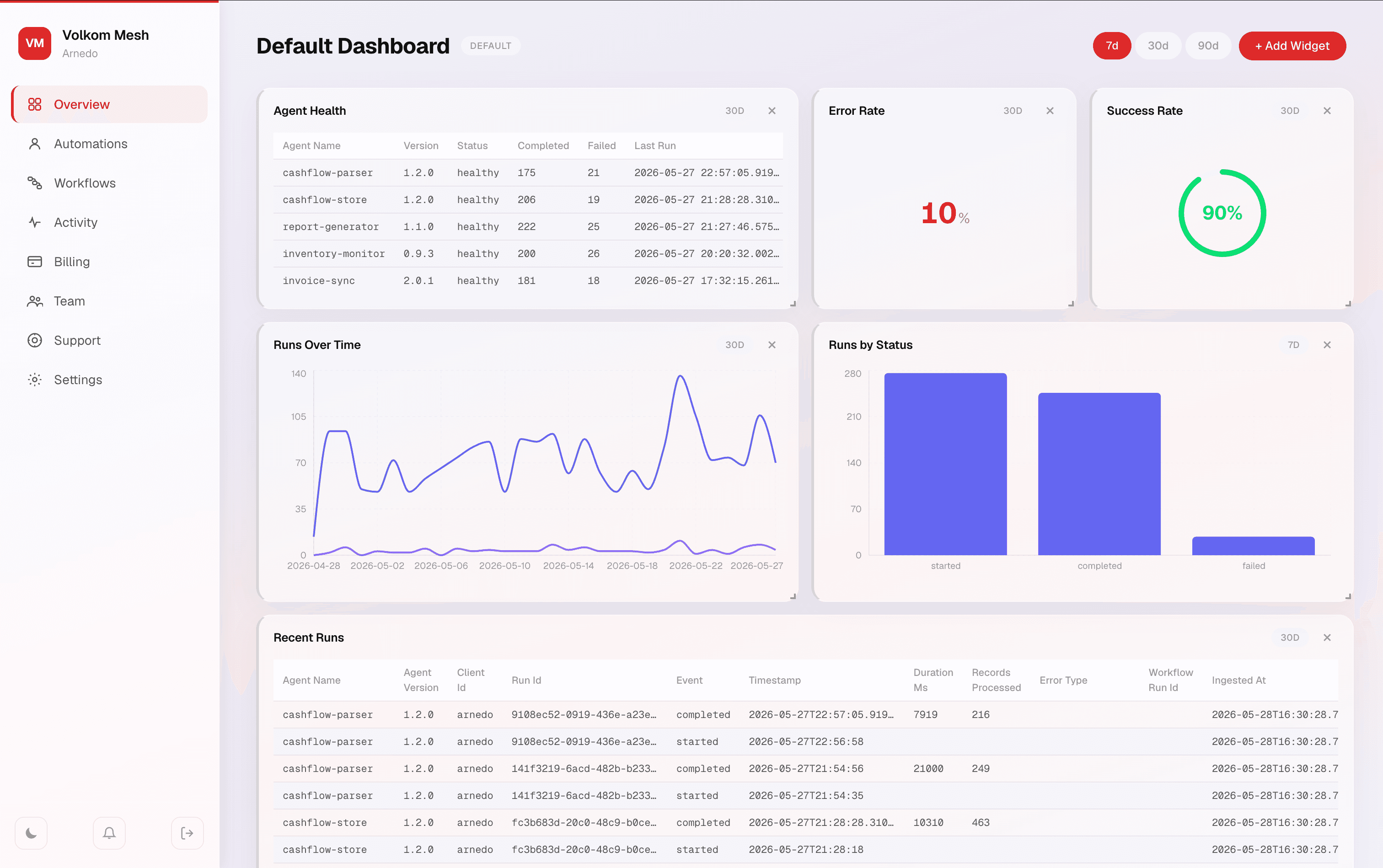
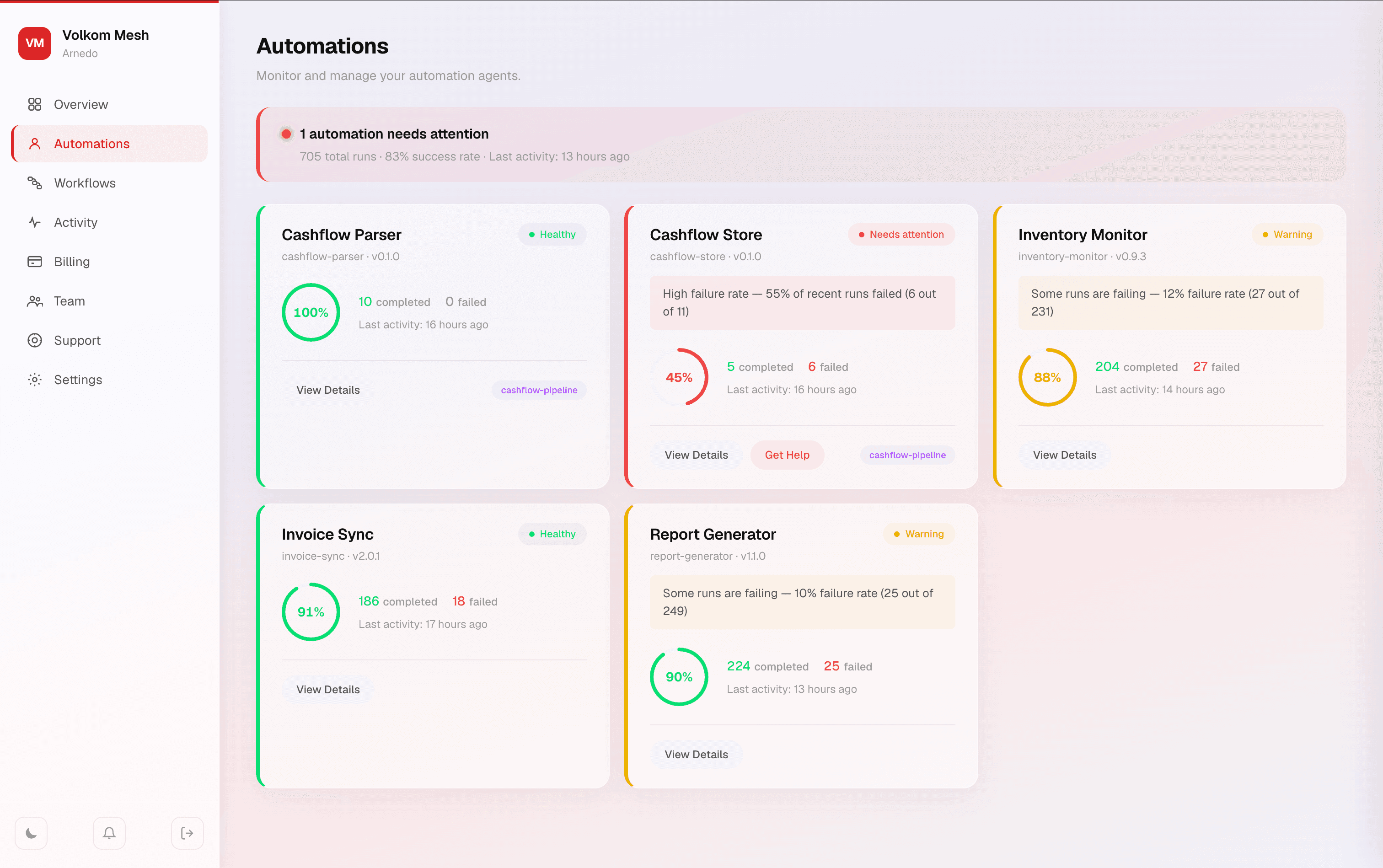
With us that part is already solved. Mesh is our platform, every process we put to work reports into it at no extra cost, and it is the part most vendors never hand over: telemetry and governance of the agent. In plain terms: you see what it did, what it gave back, and who is allowed to touch it.
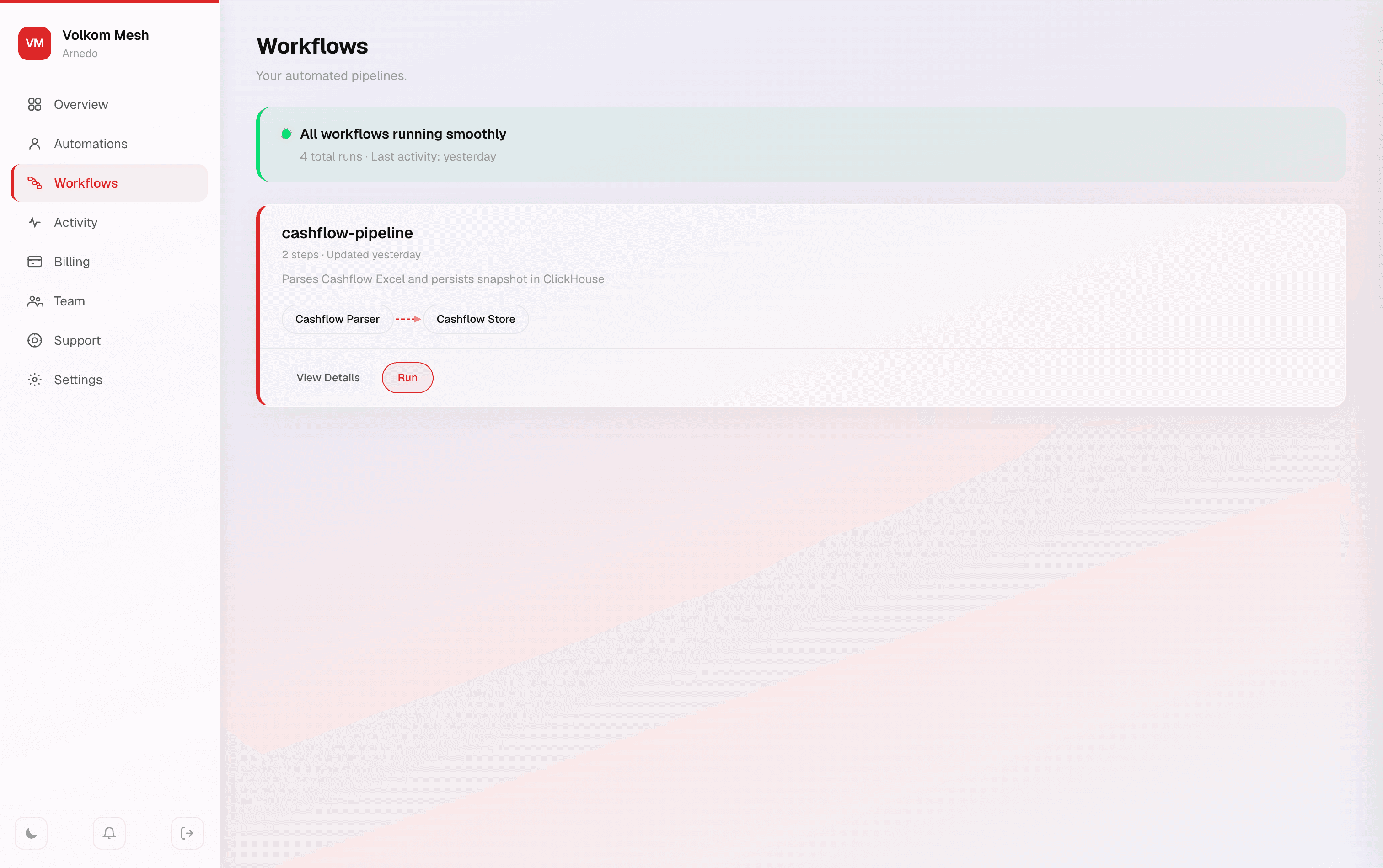
Did it run today?
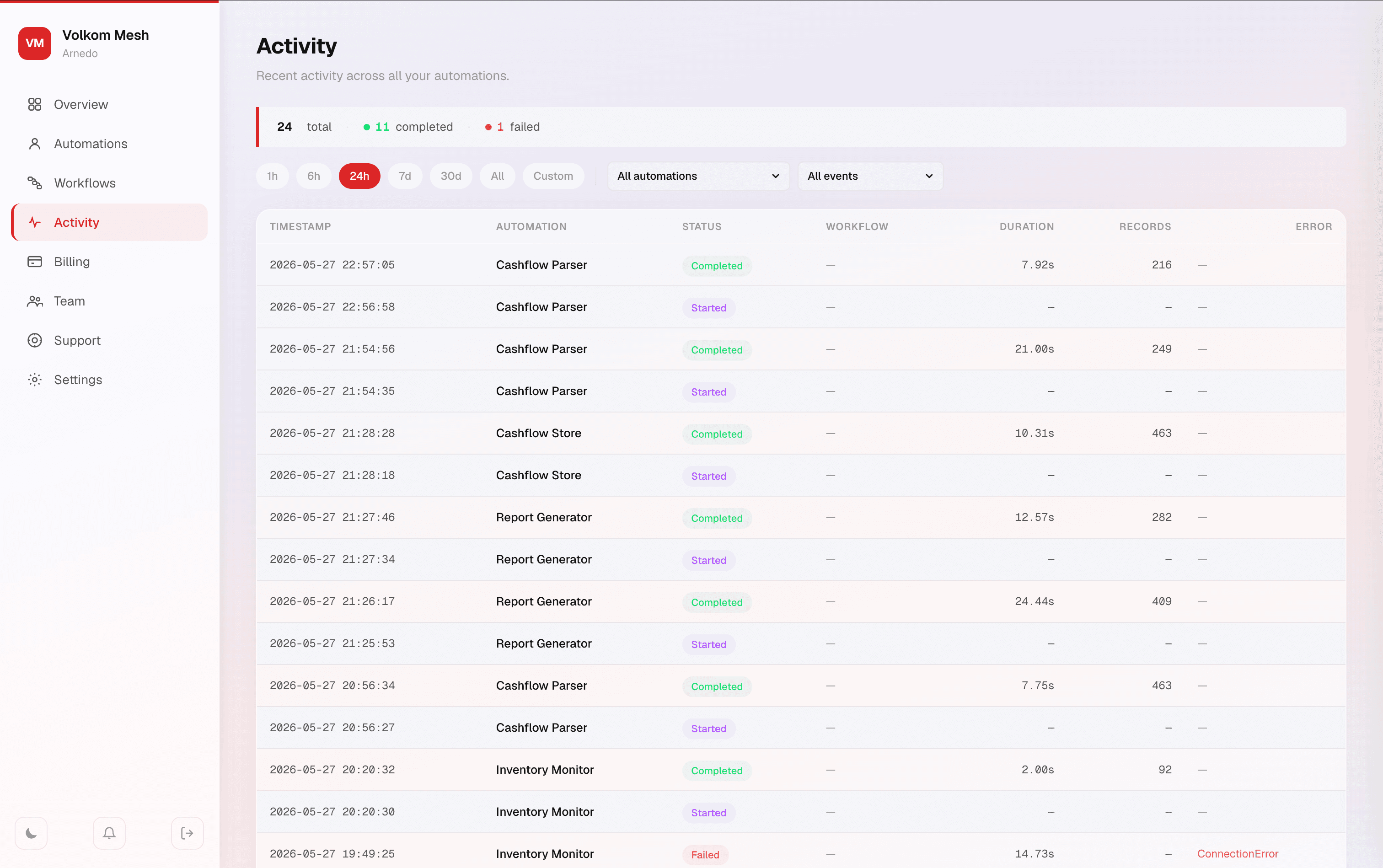
You log in and see whether it ran, when, and whether anything went wrong. Every process on the same screen, whatever system it depends on.
What did it save you?
How much volume went through, and how many hours your team stopped spending. The number you need when someone asks whether it was worth it.
Who did what
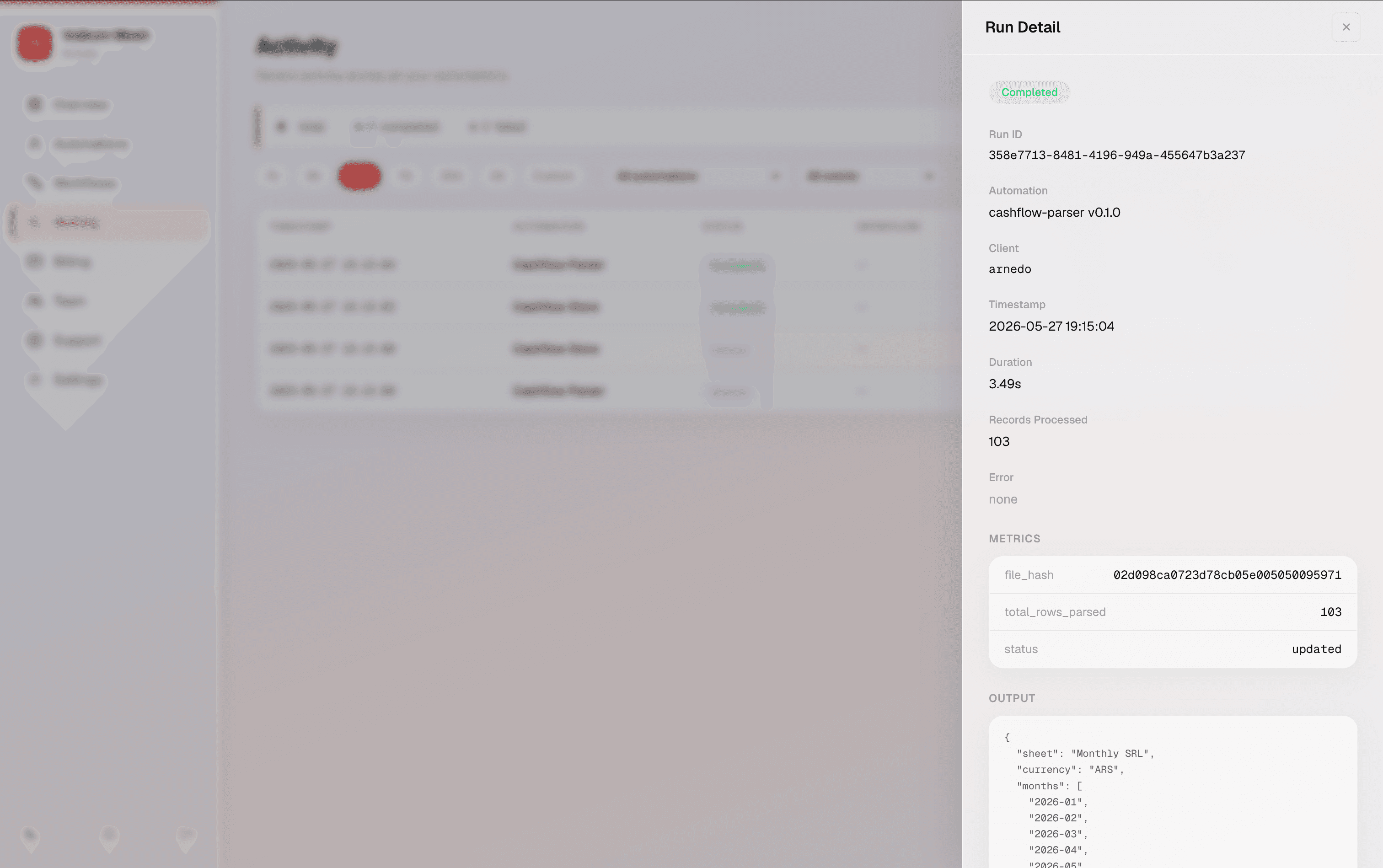
Each process has its own key and its own permissions, and it stays on record who touched what and when. This is what your auditor will ask for.
We find out first
If something fails, or a process goes quiet, it comes to us before you notice. We fix it and tell you what happened.
At the end of the month you have a real number to show, and you never had to take our word for anything.
When you compare vendors, ask this: six months from now, how do I find out on my own whether this still works and what it gave me? If there is no answer, the answer is asking them.
Download: how we work, in plain EnglishWhat everyone asks
Before you sign, this is what you'll want to know.
You are about to let something of ours touch the systems your company runs on. These are fair questions, and we'd rather answer them here than make you ask.
Where does it run, and who gets in?
You choose, based on your own rules. It can run inside your network, with your access, and we never come in: all that leaves is the record of what ran and how it went. Or we run it ourselves with the access you give us, using the smallest permission the process needs, with credentials stored encrypted and cancelled the day the process stops running. We settle which one before a line gets written.
What happens to my data?
We sign a confidentiality agreement before we look at anything of yours. Every client gets their own database: your data never mixes with anyone else's and is never reused for another client. And we work with the data the process needs, nothing more. The code we write for your process is yours to keep.
How do I know what it did?
Every run is recorded: what day, what time, what it touched and what it returned. Each process gets its own key, rotated on a schedule and revocable on its own without touching anything else. Everything we put to work now reports into Mesh, so you pull it up yourself whenever you want, and it holds up in an audit.
Is a machine deciding for me?
The rule is simple: if an action can't be undone, a person approves it first. Money moving, something leaving your company, a record that can't be rolled back — one of your people signs off before it happens. Everything that can be undone runs on its own, because stopping to ask about that would just be theater. That's how we run our own hiring agent: it writes the email, a person sends it.
And what happens to my people?
We automate the work, not the people. What you do with the hours that come free is your call, not ours. In the processes running today, the team that used to key in data now looks only at the exceptions — which is where a person was actually needed all along.
Track record
What's running today
automated processes running
Doing real work every day, in clients that are in production right now.
hours a month eliminated
The three processes further down this page, all for the same client.
less on every new process
What we build for one process we reuse on the next, so each one comes out faster than the last.
running critical processes
Large companies have trusted us with processes that can't go down since 2023.
Trusted by












Real work, and what it did
What we've built
Processes that now run on their own
Working every day, with the hours measured.
Collections from 6 banks, with nobody in front of the screen
From 12 people doing repetitive work to a process that runs on its own
See the caseAutomation · OrdersOrder statuses in a supplier's portal
Four people, three hours a day, replaced by a process that runs on its own
See the caseAutomation · DataData that was moved between systems by hand
Dozens of hours a week of copy-paste, gone
See the casePlatforms and custom systems
Complete systems we built for clients.
A digital wallet for a provincial government
An award the state used to hand out on paper, turned into digital money pegged to the dollar so inflation can't eat it. Built and launched in five months.
See the caseLarge enterprise · BeveragesThe portal 2,500 distributors buy through, rebuilt
For a major beverage distributor: the system that takes orders from 2,500+ distributors across several countries, rebuilt so it stops going down.
See the caseOther things we've built
No page of their own, but all of them shipped. If one of these looks like your situation, we'll walk you through it on a call.
Reading dental X-rays automatically
Reviewing an X-ray by eye takes minutes an image. We built a system that reads it and produces the diagnostic report on its own, in seconds.
A province's app for its citizens
An app a whole province uses can't go down. We built the infrastructure, the automated releases and the round-the-clock monitoring that keep it up.
A 200-person company that ran on spreadsheets
There was no single place to look up the right number. We implemented Odoo with the modules their industry needed, and then stayed on to keep it running.
Who we are
Volkom is a service company: we build what your operation needs and then we run it, month after month. We are based in California, with our delivery team in Buenos Aires, Argentina. We met most of our clients solving one small process for them, and ended up building a good deal more than that. Our founders have each spent 30+ years building technology for organizations that need things to actually work, not just look good in a deck.
Technology is useful when it makes your people better at their jobs. That's it.
Who we areIs yours a project rather than an automation?
Sometimes automating a step isn't enough and the whole system has to be built. We do that too, with the same team.
- Custom software
- Odoo
- Portals
- Integrations
- Cloud infrastructure
What happens next
From your message to the first process running.
- 1
You write to us
We answer within one business day, with an honest opinion on whether this is for us or not.
- 2
A 30-minute call
You tell us which process hurts. You don't need to know anything technical — who does it and how long it takes is enough.
- 3
We look at the process
About a week with the person who does it today, to see how it actually works. That's where a proposal with a closed price comes from.
- 4
First process running
The automations on this site went live in three to four weeks. From day one you watch it run on screen.
We start with one process. What comes after that, you decide with the first one's number in front of you.
Get in touch
Tell us what you need
What process is eating your team's time? Write to us. We'll get back to you within one business day with an honest opinion on whether we can help.