Reference case · Public sector · Digital money
A state award that holds its value even when the currency doesn't.
A digital wallet that replaces the paper certificate with money pegged to the dollar. The benefit doesn't lose value while it waits, and the state gets a record of every peso it hands out.
The idea
A benefit designed not to lose value while it waits.
The original award was paid in pesos, so inflation quietly taxed every student between the day they got it and the day they went to cash it. Pegging it to the dollar stops that. It's worth the same whether they cash out on graduation day or hold it for six months.
The challenge
The Government of the Province of San Luis, Argentina had run a program since 2010 that gave a cash award to every student who finished high school. It worked: provincial graduation rates climbed roughly 20% and moved above the national average.
But the way the award was handed out had a structural problem. Students got a paper certificate and went to a bank to cash it, in pesos. With Argentine inflation, that award lost value fast, whether they cashed it right away or waited. The program was being undermined by the very currency it depended on.
The program's impact was hostage to the currency it depended on. The fix wasn't a bigger award, it was a better way to hand it out.
San Luis Governor Dr. Alberto Rodríguez Saá had already named digital inclusion a provincial priority:
The first human right is one that is not born from the economy, but from science and technology.
By 2020, the province saw blockchain as the way to modernize the program, protect its value, and teach some financial literacy to students who grew up with a phone in their hand. They brought us in to build it. We were operating as AccelOne Argentina then, the company Volkom later acquired.
What we did
We built Billetera Activa, an app where every student receives their award as digital money backed one-to-one by the U.S. dollar. Because it's pegged to the dollar, it doesn't matter how far the peso falls. It's worth the same the day they get it and six months later.
The solution met what the government asked for: something that would engage students who live on their phones, information that was clear and secure, and an incentive to save rather than cash out all at once before the money lost value.
We ran everything in parallel, with analysis, design, build and testing at the same time, against a date that couldn't move because it was tied to the graduation calendar. Before a single unit was issued, an outside firm tried to break into the system to see whether it held up.
When we started this project, we knew there were opportunities to serve our community with blockchain technology, with a very specific goal in a very short amount of time. Our team was able to envision the opportunity to make a real impact. We are very grateful for the team's responsiveness and willingness to work together from the beginning — taking our idea and turning it into an application with real impact on the community, giving their engineers the autonomy to be creative and diligent.
The product
A simple app: what I have, who I send it to, what I keep.
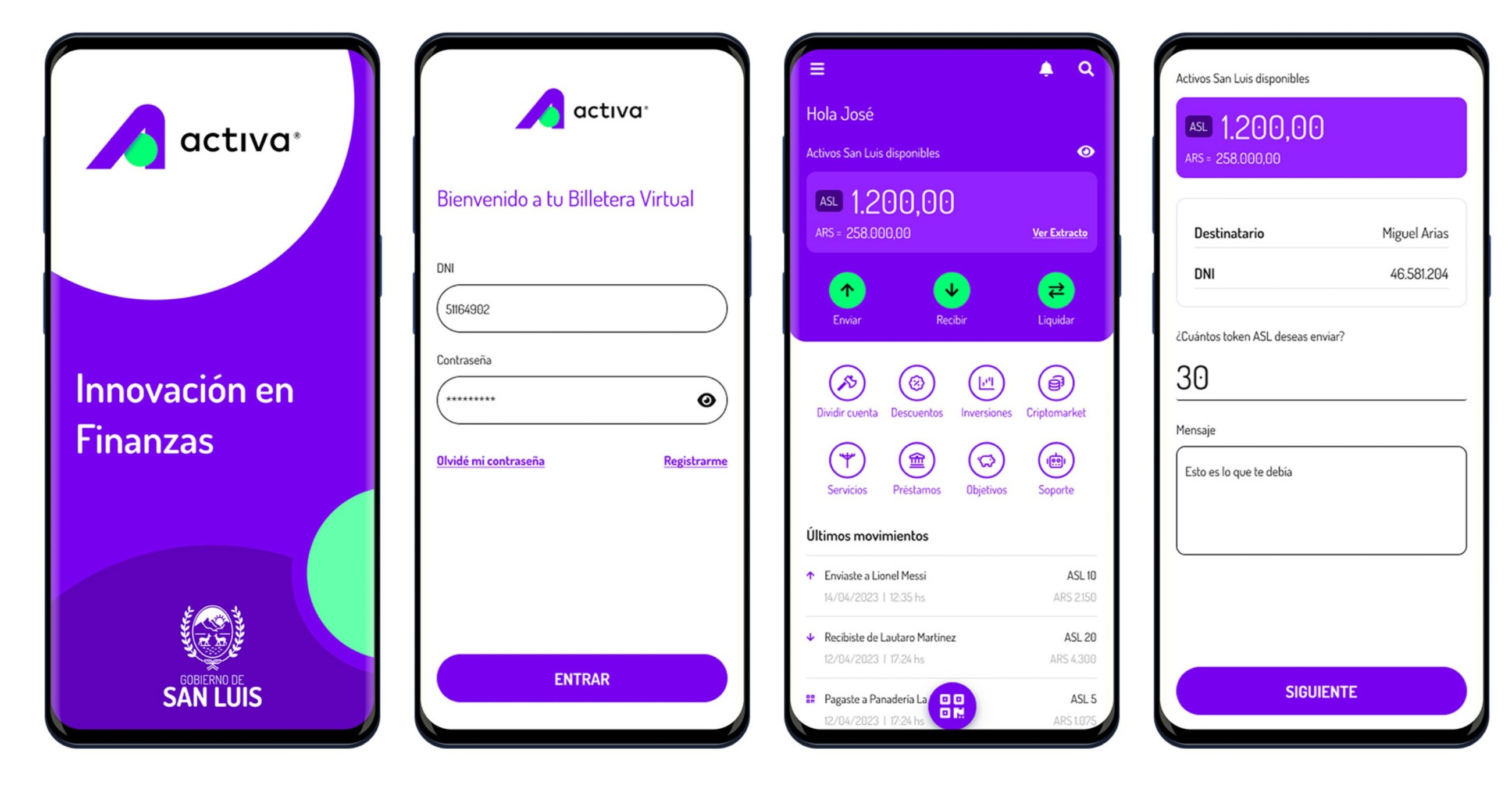
Billetera Activa. You sign up with your ID and see your balance right away, in Activos San Luis (ASL) tokens and in its peso equivalent. You can send money to someone else or pay for services from the same screen. Built for the phone, because that's where the user lives.
How it's built
Security and control
Public money demands public-grade controls. Security wasn't added at the end, it's where we started. Officials issue and manage from a console with permissions, and every movement is written to a record nobody can quietly edit.
Identity, permissions and auditability were treated as core features, verified by an independent security audit before launch.
- Two-step verification to get into any account
- Fingerprint or face check to move money
- Identity verified against the national ID
- Auditable record of everything issued and cashed
- Different permissions depending on each official's role
- Security audit by an independent outside firm
Outcomes
Beyond the first program
Room to grow was in the spec from the start. The same base can hand out and control benefits for any other group, whether that's another subsidy, a scholarship or an inclusion program, without building it again.
One platform, many programs. The state ends up with a reusable way to hand out money, not a single-use build.
Permissions configurable by user type, an auditable record in every program, and a base built to extend mean the model travels: from one province's graduates to any government's whole range of social programs.
Questions, answered
What is it, in one line?
A digital wallet that hands out the state's award as money pegged to the dollar, instead of a paper certificate that loses value.
How does it solve the inflation problem?
Every unit is backed one-to-one by the U.S. dollar. Buying power stays the same whether the recipient cashes out right away or holds for months, unlike a peso payment that thins out every day.
What is it built with?
A private blockchain record (Hyperledger Fabric), the phone app in Flutter for iOS and Android from a single build, the connections in Node.js, the government console in React, and all of it running on Amazon's cloud. Security includes two-step verification, biometric checks and identity verification against the national ID.
How fast can it launch?
This one went from idea to running in five months, against a date that couldn't move. That took analysis, design, build and testing in parallel, with an outside security audit before going live.
Does it work for other programs?
Yes. The record, the identity layer and the permissions aren't tied to this particular program, so a government can stand up new programs on the same base without building it again.
Build the rail, not the one-off benefit
Turn what you hand out by hand into something you can audit.
Volkom builds systems that turn manual processes into infrastructure you own, can measure, and can audit.
Start a conversationBilletera Activa was designed and delivered by Volkom (formerly AccelOne Argentina) for the Government of the Province of San Luis, Argentina. Metrics reflect the documented program outcomes at launch.